Okay, we’re gonna go full stream of consciousness. Barely even stopping to think.
I’m going to be one of the best coaches in the world. And I’m very excited for that.
I’m always thinking about what coaching means.
What my coaching means.
Most coaching in the world falls into one of two categories: it’s either too forceful or too gentle.
The forceful way is the hustle, ‘you don’t have enough discipline’, ‘you need to work harder’.
It’s tough love, but it’s more than tough love. It’s without regard for how triggered someone’s nervous system is in the moment.
It’s essentially built on the belief that—
—Wait. Let me rewind and talk about comfort zones.
Comfort zone discourse is broken.
Most discussion about comfort zones is too simplistic.
It just talks about whether something’s in your comfort zone or outside of it.
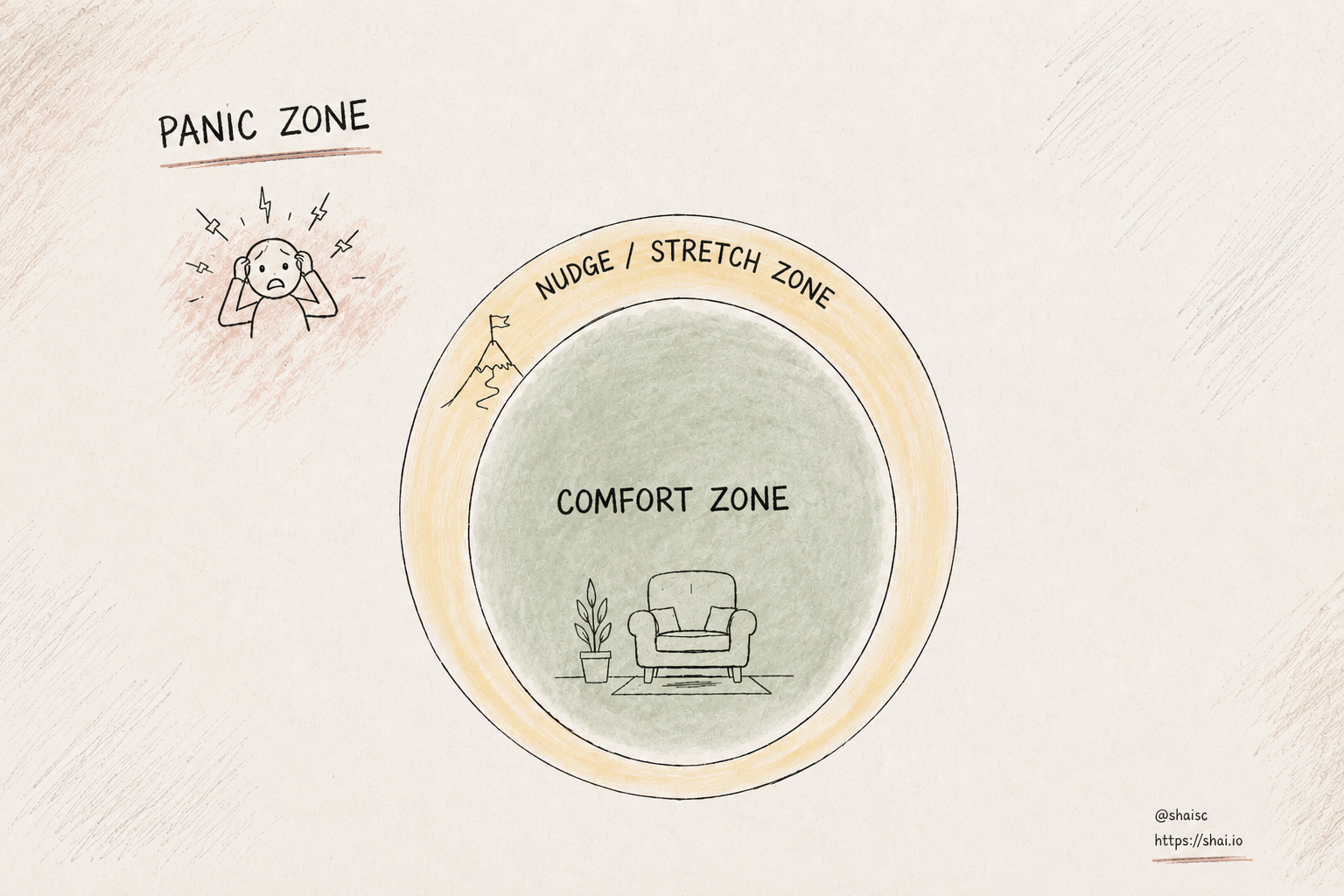
When actually the most critical part of the comfort zone conversation is adding nuance to what’s outside the comfort zone. ‘Outside the comfort zone’ can mean anything from just one tiny nudge outside of the comfort zone all the way to a full-on panic attack.
That’s not a useful category. We need to be one step more granular.
There’s your nudge zone, or your stretch zone. Just outside the comfort zone. Where things are a little uncomfortable, but also—with a general belief that you will be able to do it—your nervous system is not flooded. It’s a sort of nervous excitement.
And then everything beyond that is the panic zone. Where your nervous system is flooded. Your sympathetic nervous system is pretty activated.
Spending time in the nudge zone is awesome.
You feel like you can handle things, but there’s also enough challenge to get your teeth into that you’re making progress towards your goals.
Your comfort zone and your nudge zone are growing as you spend more time there. They expand. So you see yourself levelling up.
It’s an incredibly fulfilling place to be as a human.
Most coaching spends a lot of time in either the panic zone or the comfort zone.
Intentional panic zone is the hustle-culture world. It’s built on the fundamental belief that you are not doing things right if you are not accomplishing what you set out to accomplish.
So apply more pressure. Push harder. Essentially: resistance is something to be pushed back at. Bulldozed through.
At the other extreme we’ve got comfort zone.
So either just pandering, or… actually the common version of it isn’t quite comfort zone. It is stretch zone. But it’s theoretical.
Meaning: let’s say there’s a task that you’re wanting to tackle.
And when you sit down to do it there’s resistance. There’s a tendency to procrastinate. These kinds of things.
The first approach is “it doesn’t matter that you’re feeling resistance, giving in to that is weak, bulldoze through it”.
The more theoretical path that I was mentioning is to go deep into exploring the resistance.
We say “Okay, if we’re feeling resistance, we don’t have to go and do the task. Let’s explore what’s going on with your system.”
Maybe with things like IFS. Maybe with other approaches. Let’s welcome the resistance. Love the resistance. Interact with the resistance.
But we’re stepping back from the task to navigate your inner world instead.
In general, at least for myself and the people I’ve worked with, if I had to err on the side of one, it would be the more gentle one. Because at least it’s teaching self-compassion. And it’s dissolving shame. Which is keeping things in place.
I’ve only ever seen the forceful method cause more tension and blocking in the system than there was before. At least long-term. It might work very short-term to see some results. But I don’t see it as being sustainable. It’s pushing someone more into sympathetic nervous system activation.
And we’re not wired to learn when we’re in that place.
We learn that the world isn’t safe and that there’s something wrong with us more than we learn a new habit.
What I’ve seen consistently work best…
…is to recognize that a skilled, present coach can lend some resourcing and accelerate the comfort-zone growth process.
Meaning:
There’s a huge swathe of tasks that are in the panic zone.
But, when you’re getting some resourcing or co-regulation from another person, that in itself temporarily expands your comfort zone and your nudge zone.
A lot of tasks that were outside of it become inside of it.
This is sort of what’s happening with the phenomenon of body doubling.
A present, highly compassionate coach can serve this purpose in a dramatic way, allowing someone to feel safe enough to do something that would have felt unsafe before.
Is this a long-term solution? Absolutely not. If you then became reliant on that other person, for me that’s not the ideal outcome.
But, because you’re not too far in your panic zone, you’re actually learning, on a felt level, from what’s happening.
Once you accomplish the task your system is able to learn that you were able to do it.
And that it felt good.
It’s essentially stabilisers for a bike. In learning with them, and doing it in that way, you become better equipped to handle similar situations without the help of someone else.
It’s the same thing that happens when children are growing up.
The job of a parent is to initially co-regulate. But within that they’re also teaching you to self-regulate. Or be able to co-regulate with other people.
Those courage credits are transferable. You’re learning that you are able to do things. And you’re doing it in this incremental way. And you’re getting shit done that you’ve maybe been avoiding for a long time.
Are there tasks that are too far into the panic zone?
Absolutely.
Are there actions that, even with a coach guiding you, would still be too much? Absolutely.
But not as often as you’d think.
To me, a lot of the essence of being a good coach is being able to take someone on that journey.
From feeling unsafe in something (a task, or a relationship dynamic, or a situation), and so usually avoiding it, to feeling empowered and safe to face these things themselves. In a much more accelerated way than if they were trying to navigate there themselves.
If you imagine a hike up a mountain, there might be a very steep path that’s very challenging to navigate.
The job of the coach is to help show someone the shallower, more winding path.
The one that still leads high up the mountain.
I think often there is such a path. You have to be very attuned to their nervous system. You have to be very grounded in your own nervous system.
For me, that’s a lot of the joy of coaching.
Real-time navigating someone through that path where it feels good for them to do that.
Maybe at first they feel like they need you there for it. But they are quickly learning that they are able to resource that from themselves in more and more situations.
And when that’s not the case? Then absolutely it can be time to take a pit stop on this mountain hike. Maybe that is where we go more into compassion for what’s happening. Interact with the resistance.
Or various other things that will help bring someone back to a more grounded place.
Really I see a hierarchy or a set of levels that you can play this at.
- Would it make sense and feel accessible and fun to directly step into the situation you’re avoiding and see what comes up and help you navigate that with some co-regulation? If so, awesome
- If the task doesn’t lend itself to that or that’s too triggering, the next level down is: can we create a simulation, a playground, where you get to explore that similar feeling coming up but in a space that you know is safer? Essentially let’s play this in the flight simulator rather than going directly to the plane on day one
- If that is also too much, then go to a place that’s maybe more abstract from the task at hand, take a deeper dive into the semantics or whatever else is coming up, and work your way up more gradually
But the point of all of this is to optimize for the coaching session being something that feels enjoyable, fun, light, and playful—because we’ve increased the safety or decreased the stakes, but in a way that’s directly transferable (on a body level, no ‘trying’ required) to the real world. I don’t want the kind of coaching that feels super heavy and intense and needs tons of recovery time afterwards and that, even though you know it’s helping you, you’re also dreading it a little bit.